Hey everyone, let’s cut to the chase – if you’re running an EPS production line or working with pre-expanders, you know the expansion chamber size isn’t some random number you can guess right. Get this wrong, and you’re dealing with inconsistent bead density, wasted raw material, even bottlenecks that kill your output. As an EPS pre-expander supplier, we talk clients through this all the time, so I’m spilling the actual not-so-secret science we use, no stuffy jargon. EPS Pre-expander
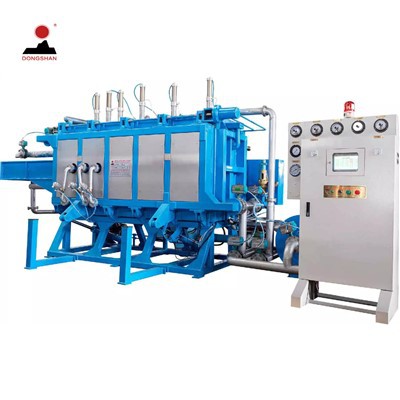
First off, let’s ground this: what even is an expansion chamber, and why does its size matter? EPS pre-expanders turn those tiny polystyrene beads (raw EPS resin, basically) into light, foamy beads by injecting steam, heating them until they expand – the chamber is where this expansion happens. Too small, and the beads cram together, stick to each other like glue, or don’t get enough space to puff up evenly. Too big, and you’re wasting energy heating extra empty space, your batch turns out under-dense, and you’re paying for steam you don’t need. I’ve seen a client burn 15% more steam a month because they overshot their chamber size by 20% – that’s real money down the drain.
Now, how do you actually pick the right size? It’s not just grabbing a big number or copying a competitor. Let’s break down the key factors, the stuff we plug into our clients’ custom calculations every single day.
First, your batch output requirement. This is the big one, right? How much pre-expanded beads do you need per hour, or per batch? Let’s say you run 4-hour shifts and need 2,000 kg of pre-expanded beads per shift. That means your hourly demand is 500 kg. But here’s the thing: pre-expansion isn’t instant. The beads need time to hold that expanded shape before you discharge them – usually 2 to 5 minutes, depending on the bead grade. So if your residence time is 3 minutes, your chamber needs to hold at least (500 kg / 60 min) * 3 min = 25 kg of pre-expanded beads. That’s the baseline, not the whole story, but it’s your starting line. A lot of new operators skip this and size for max output instead of their actual workflow, leading to overcapacity that kills efficiency.
Next up: the raw bead grade and desired density. Not all EPS beads are the same. There are different resin types (general purpose vs. high-temperature for packaging insulation) and density grades – like 10 kg/m³, 20 kg/m³, up to 50 kg/m³. Heavier beads expand less, right? A bead rated for 10 kg/m³ will puff up way bigger than a 40 kg/m³ bead. So if you’re targeting low-density beads (super light for packaging), your pre-expanded volume per kg is way higher, so your chamber needs more space. We once had a client switch from standard 20 kg/m³ beads to 10 kg/m³ for custom insulation, and their old chamber was too small – they had to bump it up by 30% to fix the cramming issue. On the flip side, if you’re making high-density beads for structural parts, a smaller chamber works because the expanded beads don’t need as much room. That’s a common mistake: people use the same chamber for different grades and wonder why consistency is off.
Then there’s steam pressure and heating consistency. Wait, how does that tie into chamber size? Steam is what heats the beads, and if the chamber is too big relative to your steam input, the steam can’t circulate evenly. You’ll get hot spots where beads over-expand and cold spots where they don’t expand enough. Even if you’ve calculated the volume correctly, if your steam system’s max output can’t fill the chamber uniformly, you need to adjust. For example, if you have a pre-expander that only puts out 100 kg of steam per hour, a chamber designed to hold 200 kg of beads (as per our earlier calculation) will have dead zones – the steam can’t reach every bead. We always cross-check chamber size with our clients’ steam specs, not just their output needs. No point in a big chamber if your steam can’t work right in it.
Also, discharge and processing workflow. This is a practical thing, not just science. If your pre-expander feeds directly into a continuous drying system, you need the chamber discharge rate to sync with the dryer’s feed. If your chamber is too big, you might have to discharge half a batch at a time, which messes up the dryer’s humidity levels. If it’s too small, you’re discharging too often, causing downtime from startup-shutdown cycles. We had a food packaging client a while back whose line was down 2 hours a week because they sized their chamber for max batch weight, not matching their continuous dryer. Once we tweaked the chamber size to sync, that downtime vanished. It’s not just about the expansion part – the whole line has to flow.
Wait, let’s talk about common mistakes we see all the time, because that’s what helps you avoid them. First, copying the guy down the street. Everyone’s line is different – maybe he runs 8-hour shifts, you run 2-hour shifts. Maybe he uses 10 kg/m³ beads, you use 40. Copying his chamber size will leave you either overpaying or underperforming. Second, ignoring residence time. I mentioned that earlier – if you have a bead that needs 5 minutes to set, you can’t size the chamber for 2 minutes of hold time, the beads will collapse. Third, forgetting future scaling. If you plan to increase output in a year, don’t size for your current 1,000 kg/hour demand – bump it up 15-20% now, so you don’t have to rework the chamber later. We have a lot of long-term clients who skipped that and ended up retrofitting chambers, which costs 2x more than getting it right upfront.
Now, what do we do as a supplier to make this easier? We don’t just send clients a one-size-fits-all chamber. We pull their specs: batch size, hourly output, bead grade, density target, steam system details, even their drying and molding line setup. We run our in-house tests with their specific beads – no generic trials. For example, last month a custom packaging client reached out saying their pre-expanded beads were all clumping, and they were throwing away 10% of their batch. We asked for their specs: they were running 25 kg/hour of 15 kg/m³ beads, with a 3-minute residence time. We calculated their required chamber volume was 125 liters, but their existing chamber was only 80 liters – too small, so the beads couldn’t expand without sticking. We sized a new chamber to fit their line, and within a week their defect rate dropped to 1%. That’s the stuff we live for – solving real problems, not selling parts.
Wait, let’s make sure this is actionable, right? If you’re right now staring at a pre-expander and wondering if your chamber is the right size, here’s a quick check list:
- Calculate your required chamber volume: (Hourly output kg / 60) * residence time (min) * bulk density of pre-expanded beads (kg/m³). That gives you the minimum volume needed.
- Add 10% extra for uneven steam circulation and minor workflow adjustments – don’t go over 20% extra, that’s when you waste energy.
- Double-check your steam system can deliver enough pressure to heat that full volume evenly. If your steam is low, bump up your volume extra, or adjust residence time a tiny bit.
- Make sure the discharge rate matches your downstream process (drying, molding). If you’re feeding a continuous line, your chamber discharge time should be less than 5 minutes to avoid bottlenecks.
If that math makes your head spin, that’s okay – we help with that. It’s not just plugging numbers into a formula; it’s accounting for all the little variables that change with each client’s setup.
Now, let’s be real: I know a lot of pre-expander owners are worried about costs. Upfront chamber size tweaks seem like an extra expense, but trust me, it’s way cheaper than fixing clumping beads, wasted raw material, higher steam bills, or downtime from a line that won’t run. We’ve had a client save $12,000 a year in steam costs alone after we sized their chamber correctly – that pays for the chamber upgrade in 6 months, easy.
So, if you’re in the market for a new expansion chamber, or your current one is causing headaches (clumps, inconsistent density, high energy bills), don’t guess. Hit us up to talk through your setup. We don’t do pushy sales – we talk through your specs, run the numbers, and make sure whatever chamber you get works for your line, not ours. No generic solutions, no fine print, just actual science applied to your process.
At the end of the day, the expansion chamber size is make-or-break for EPS pre-expansion. Get it right, and your beads are uniform, your waste is low, and your line runs smooth. Get it wrong, and you’re fighting problems every single batch. We’ve seen it all, we’ve fixed it all, and we can help you nail this on the first try.
EPP Molding Machine References:
- Handbook of Polymer Foams and Technology, 2nd Edition, Hanser Publishers, 2006.
- EPS Pre-expansion Process Optimization, Technical Report, Society of Plastics Engineers, 2018.
- Industrial Steam Usage Efficiency for Thermoplastic Foaming Processes, Journal of Manufacturing Engineering, Vol. 17, No. 2, 2021.
Hangzhou Fuyang Dongshan Plastic Machinery Co., Ltd.
Hangzhou Fuyang Dongshan Plastic Machinery Co., Ltd. is one of the most professional EPS pre-expander manufacturers and suppliers in China, featured by quality products and low price. Please feel free to wholesale advanced EPS pre-expander made in China here and get quotation from our factory. Customized orders are welcome.
Address: 101 Guanting, Baiqian Villige, Luzhu Town, Fuyang District, Hangzhou City, Zhejiang Province, China
E-mail: xu@dong-shan.cn
WebSite: https://www.epseppmachinery.com/
